Why Most Industrial 3D Printing Failures Are Preventable
Author: Richard Wooldridge, CEO, Raplas Technologies
A common misconception I hear from manufacturers is that industrial 3D printing is inherently unpredictable.
It’s an understandable perception. Many organisations have experienced failed builds, inconsistent quality, or projects that never progressed beyond prototyping. Too often, these experiences lead to the conclusion that additive manufacturing (AM) isn’t ready for production.
In my experience, however, most industrial 3D printing failures aren’t technology failures.
They’re process failures.
The real question isn’t whether AM works. It’s what it takes to make it work reliably and repeatedly.
The Importance of Choosing the Right Tool for the Job
Many manufacturers begin their AM journey with desktop systems. These machines are excellent for learning, prototyping, and proving concepts.
The challenge comes when businesses try to scale those systems into production environments.
I’ve seen organisations struggle with warping, layer separation, dimensional inaccuracies, poor repeatability, and inconsistent surface quality. In many cases, the issue isn’t the technology itself, but a mismatch between the application’s requirements and the equipment being used.
Every manufacturing technology has its place. The key is ensuring the machine is capable of delivering the accuracy, repeatability, throughput, and process control the application demands.
Repeatability Matters More Than Speed
The AM industry often focuses on speed, resolution, and material performance. While these are important, repeatability is what ultimately determines manufacturing success.
Producing one good part is relatively easy. Producing the same part to the same specification hundreds or thousands of times is where the challenge begins.
Variation in machine performance, environmental conditions, material behaviour, or build preparation can all impact results. The manufacturers achieving the greatest success are those who focus on controlling these variables rather than simply increasing output.
At Raplas, this focus on repeatability has always shaped our approach. Features such as machine rigidity, thermal stability, and process control may not be the most exciting specifications, but they are often what separate successful production environments from inconsistent ones.
Process Control Is the Difference
One of the biggest mistakes manufacturers make is focusing solely on the printer.
Successful AM depends on the entire workflow, from design and material selection through to build preparation, validation, post-processing, and quality control.
For example, a build may fail due to poor support placement. A part may print successfully but fail inspection because of dimensional inaccuracies. A material may look suitable but fail to deliver the performance required in service.
These challenges aren’t solved by hardware alone.
They’re solved through process control.
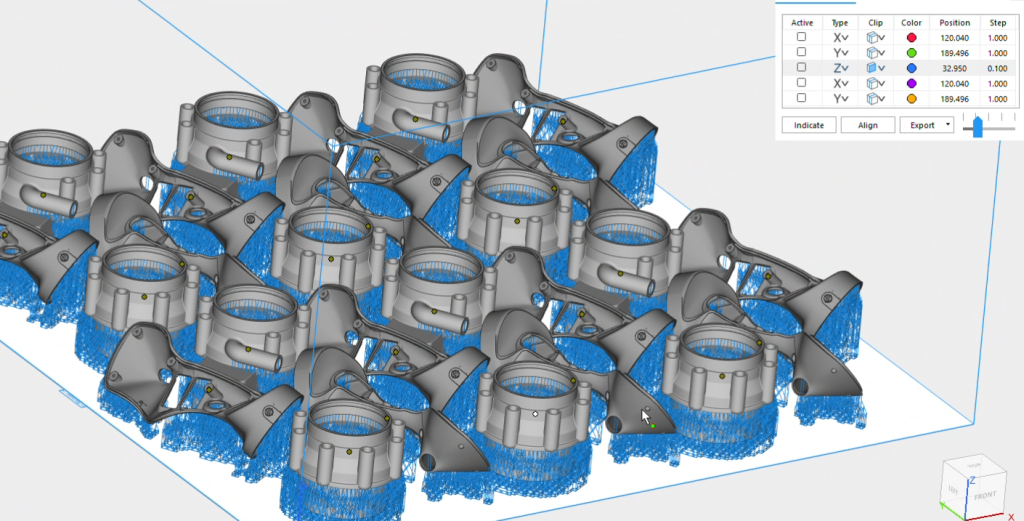
This is why software has become such an important part of industrial AM. Poor orientation, inadequate supports, or unsuitable build strategies can introduce problems before a build even begins.
At Raplas, we developed SmartBuild in collaboration with Materialise to help standardise build preparation, optimise support strategies, and reduce operator variability. The goal is simple: create more consistent and repeatable manufacturing outcomes.
Building Stability into the Process
Another lesson many manufacturers learn is that stability drives reliability.
Small variations in temperature, machine rigidity, calibration, or movement accuracy can have a significant impact on part quality, particularly as parts become larger or more complex.
This is one reason industrial systems are engineered differently from entry-level machines.
Our PR series, for example, is designed around a stable manufacturing environment, using rigid granite construction and controlled process conditions to minimise variation and improve repeatability.
Ultimately, manufacturers don’t just need successful builds. They need successful builds every time.
Looking Ahead
As AM continues to mature, the conversation is changing.
It’s no longer about proving that 3D printing is possible. It’s about making it predictable, scalable, and commercially viable.
The manufacturers seeing the greatest success aren’t necessarily those with the newest technology. They’re the organisations that select the right equipment, validate materials, standardise workflows, and continuously improve their processes.
Most industrial 3D printing failures aren’t inevitable.
They’re preventable.
A Question for Manufacturers
If you’re struggling with failed builds, inconsistent quality, or challenges scaling additive manufacturing into production, ask yourself:
- Are we using the right machine for the application?
- Are our materials properly validated?
- Are our workflows repeatable and standardised?
- Are we actively monitoring and controlling key process variables?
The answers to these questions will often reveal more than another machine specification sheet ever can.
Get the process right, and additive manufacturing becomes what it was always intended to be: a reliable, repeatable, and scalable manufacturing technology.
Ready to reduce build failures?
Successful industrial 3D printing requires more than advanced hardware. With the right process control, software, and expertise, you can achieve consistent, repeatable results.