
The True Cost of Cheap 3D Printers in Industrial Environments
By Michael Yeatts— CFO, Raplas Technologies
After more than 30 years in investment banking, one pattern became very familiar: capital decisions fail when they focus on price rather than value.
I’ve seen organisations buy the “cheapest” option only to spend years paying for the consequences — in maintenance, labour, downtime, and the slow erosion of capability. Industrial 3D printing is no different. In fact, the gap between sticker price and true cost of ownership is wider here than in most sectors.
The market today broadly divides into two camps:
- Low-cost machines that look impressive on day one but struggle to sustain industrial performance.
- Legacy-branded machines with high price tags but architectures that have barely evolved in a decade or more.
Both categories create financial blind spots that are easy to miss at the point of purchase and expensive to discover later.
What follows is not a sales argument, but a CFO’s perspective on how value is created — or destroyed — over the lifetime of an industrial resin-based 3D printer.
1. Future-Proofing: The Hidden Multiplier in Capital Efficiency
One of the most overlooked questions in additive manufacturing is simple: Will this machine still be relevant in ten years?
Many industrial printers are built on legacy architectures. Software updates slow, hardware becomes incompatible, and customers find themselves locked into a technology that cannot evolve. The depreciation schedule may say ten years, but the useful life is often half that.
Raplas was built on the opposite philosophy: machines should remain compatible with future hardware and software. A decade-old system at our Wales HQ runs the same SmartBuild software as a new machine. That is not common in this industry.
From a financial standpoint, the difference is stark. A machine that remains current for 10–15 years has a fundamentally different cost profile from one that becomes outdated in five.
2. Component Strategy: Accessible vs Proprietary
Another quiet cost driver in this industry is the use of proprietary components. They tend to be more expensive, slower to source, and tied to older designs.
An accessible component strategy — where parts can be replaced or upgraded with current technology — avoids the “legacy tax” that accumulates over time.
This is not about headline savings; it is about avoiding structural cost escalation over the machine’s life.
3. Longevity and the Economics of “Buy Once”
Planned obsolescence is a surprisingly common feature of industrial equipment. Machines are designed with a finite horizon in mind, and customers are expected to replace them on a predictable cycle.
Raplas takes a different view: if a machine is engineered properly, it should serve for a decade or more, and new capabilities should be retrofittable.
The financial logic is straightforward. If one machine lasts twice as long as another, its effective annual cost is halved — even before considering productivity differences.
4. Accuracy Across the Entire Build Platform: A Quiet but Significant Cost Driver
Accuracy variation across the build platform is rarely discussed in marketing materials, but it has real operational consequences.
Many machines deliver their best accuracy in the centre, with performance degrading toward the edges. Operators compensate by avoiding those areas or accepting higher rejection rates. The result is underutilisation of the platform and more builds to achieve the same output.
A machine that maintains uniform accuracy across the entire platform avoids this hidden inefficiency. If 20–30% of a competitor’s platform is effectively unusable for precision parts, the impact on throughput — and therefore cost per part — is substantial.
This is not a theoretical issue; it is a daily operational reality.
5. Software as a Productivity Lever, Not an Accessory
Software is often treated as an add-on in this industry. In practice, it is one of the most powerful determinants of cost per part.
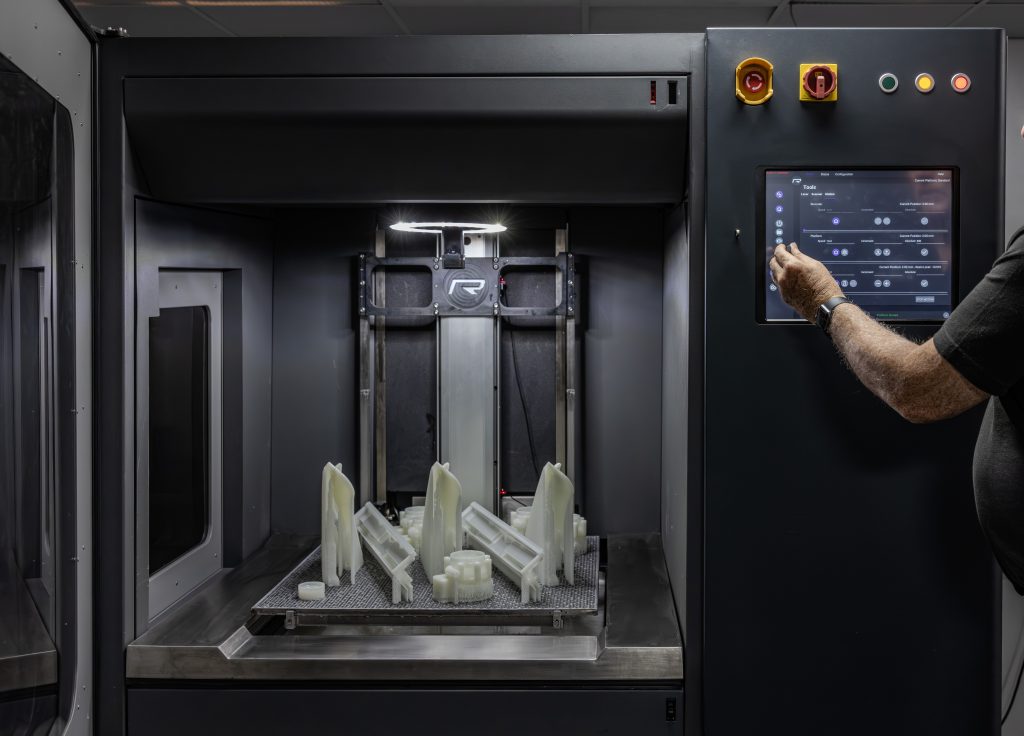
SmartBuild, for example, allows thin walls, thick sections, intricate geometries, and large flat surfaces to be built simultaneously with optimal vector settings. This maximises platform utilisation and reduces the need for separate builds.
Equally important is the reduction in post-processing. If a skilled technician costs £40–£50 per hour, even modest reductions in manual finishing translate into meaningful annual savings. Labour is one of the few costs that compounds relentlessly; anything that reduces it has long-term financial significance.
6. Open Materials: Flexibility as a Financial Strategy
Material strategy is another area where long-term value is often overlooked. Closed ecosystems create dependency. Open ecosystems create choice.
Allowing qualified third-party resins gives customers the ability to manage cost, performance, and supply chain risk. The exact savings vary, but the strategic benefit is consistent: freedom to choose is financially valuable.
7. Laser Lifecycle Management: Downtime Is the Real Cost
Lasers degrade — that is unavoidable. What differs is how manufacturers handle the replacement cycle.
Remote optimisation, trade-in programmes, and the ability to keep a laser operational while a replacement is arranged all reduce downtime. And downtime, in industrial environments, is often the most expensive line item of all.
The cost of the laser itself is rarely the issue. The cost of a machine sitting idle is.
8. Material Development Without Waste
Testing new resins on large-format SLA machines traditionally requires filling a full vat — often around 300 litres on larger systems. This creates a barrier to experimentation and ties up working capital.
A Material Development Kit that enables full-quality testing with 10 litres of resin changes the economics entirely. It reduces waste, accelerates R&D, and lowers the cost of innovation.
For organisations exploring new applications, this is not a convenience — it is a financial enabler.
Value Is a Long Game
CFOs are not responsible for choosing the shiniest machine or the one with the most persuasive brochure. We are responsible for ensuring that capital is deployed in a way that creates long-term value.
When you look at industrial 3D printers through that lens — not the sticker price — the questions become clearer:
- Will this machine remain relevant for a decade?
- Can it evolve with our needs?
- Does it minimise labour?
- Does it maximise throughput?
- Does it avoid vendor lock-in?
- Does it reduce downtime?
- Does it support innovation without waste?
These are not sales questions. They are capital allocation questions.
And in my experience — whether in banking or manufacturing — the organisations that ask them early are the ones that avoid expensive surprises later.
Make a smarter long-term 3D printing investment.
Speak with our CFO or member of the team to evaluate the true cost, flexibility and lifetime value of your options.