
Reducing Print Failures: A Practical Guide for Engineers
By Marko Aubel, Head of Technology, R&D and Support, Raplas Technologies
Print failure is usually a workflow failure
Every engineer working with additive manufacturing has seen failed prints. A part detaches from the platform. Supports break. Thin walls distort. Fine features disappear. A build completes, but the part fails inspection. In SLA, these problems are rarely caused by one isolated setting.
The practical question is how to reduce 3D print failures by controlling the complete workflow: machine, material, orientation, supports, exposure, resin temperature, recoating, cleaning, post-curing and inspection.

| Raplas PR systems should be understood as industrial SLA platforms. Their value is not only that they build parts, it is also that they support a controlled route from material development to repeatable production. |
Orientation is the first failure-control decision
Part orientation is one of the most important decisions in SLA. It affects layer cross-section, drainage, support contact, stress distribution, surface quality, dimensional accuracy and build time. A poor orientation can create large unsupported areas, trapped resin, high stress, difficult support removal or distortion in critical features. A better orientation reduces risk before the machine even starts.
In practical Raplas work, this is especially visible when comparing flat and upright strategies. Flat printing can be very efficient for certain split parts because it reduces height, avoids unnecessary supports and can shorten the build time. Upright printing can preserve single-piece geometry and reduce assembly work, but it may increase build time and require a different support strategy. SmartBuild helps make this decision more systematic.
Supports must control the part, not fight the process
Supports are one of the most common causes of failure and rework. Too few supports can lead to movement, broken features, distortion or detachment. Too many supports can increase resin use, extend finishing time, damage surfaces and make the part harder to clean.
For SLA failure troubleshooting, support analysis should always include orientation, material behaviour, exposure settings and part geometry. Support failure is often a symptom, not the root cause.
| Overcure and heavy supports: In Raplas resin testing, tougher or impact-type materials have shown stronger overcure behaviour or heavier support attachment if exposure and support strategy are not tuned together. The part may print, but support removal and surface finish can become unnecessarily difficult. |
Material behaviour must be validated properly
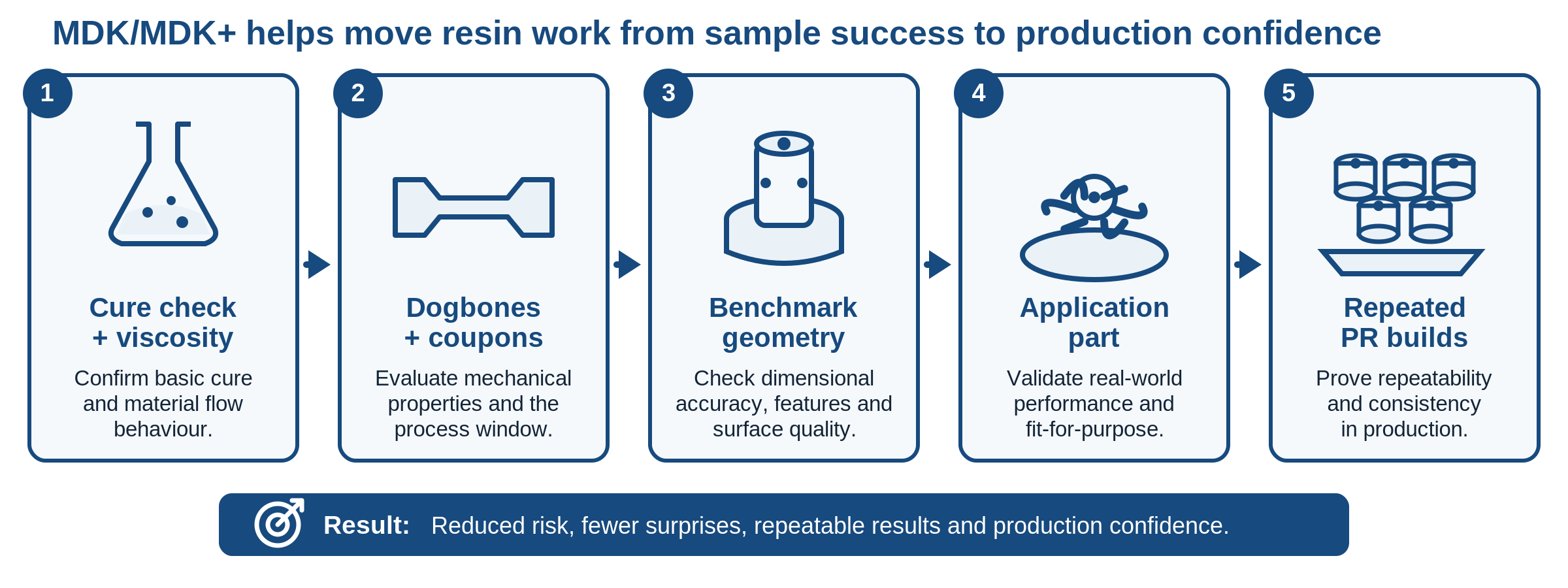
Material choice is one of the biggest drivers of print success. A resin that works well on a small test piece may behave differently on a large component, a thick section, a lattice structure or a support-heavy geometry. Important material factors include viscosity, cure depth, green strength, shrinkage, toughness, stiffness, flexibility, thermal response, separation behaviour, post-cure stability and long-term dimensional performance.
Dogbone testing is a good starting point, but it is not enough on its own. It helps compare mechanical behaviour and cure response, but real confidence comes from combining coupons with application-relevant parts. MDK and MDK+ are valuable because they support structured resin development on real PR systems. Instead of relying only on supplier datasheets, users can test how a material behaves under realistic Raplas processing conditions.
The value of simple practical tests
| Test type | What it exposes | Use in failure prevention |
| Dogbones | Mechanical response and cure consistency | Compare materials and post-cure behaviour |
| Small benchmark parts | Detail, edge growth and dimensional response | Detect exposure or cleaning issues early |
| Impeller-style parts | Blades, curved surfaces, wall transitions and supports | Expose application-like geometry risks |
| Large flat parts | Warping and stress | Validate orientation and thermal/process stability |
| Lattice cylinders | Drainage, support and stability | Reveal resin flow and cleaning challenges |
| Repeated builds | Precision and process drift | Confirm the workflow can be reproduced |
This staged approach is more useful than jumping directly from a small coupon to a large customer part. The goal is to understand the process before the expensive failure happens.
Environment control improves the success rate
For improving 3D print success rate, the print environment must be controlled. Resin temperature, contamination, mixing, platform condition, exposure stability, recoating, cleaning and post-curing all influence the final result. Temperature is especially important because it affects viscosity, flow, cure behaviour and stress. A resin that prints well under one condition may behave differently if the process environment changes.
Raplas PR systems are designed for industrial users who need repeatability. Stable process conditions help reduce unexpected failures and make successful builds reproducible.
Common failure modes and practical fixes
Part detachment often points to platform adhesion, support strategy, orientation, exposure, contamination or resin condition. The solution is not always simply more exposure. More exposure may improve adhesion but can also increase overcure and reduce dimensional accuracy.
Warping or distortion may be caused by internal stress, large unsupported regions, poor orientation, uneven wall thickness, thermal variation or post-cure behaviour. Broken supports often indicate excessive load, poor support placement, insufficient contact size or an orientation that creates unnecessary forces. Loss of fine detail may result from overcuring, incorrect exposure, unsuitable resin behaviour, cleaning damage or excessive post-curing. Dimensional drift can come from calibration, shrinkage, thermal instability, material behaviour or inconsistent post-processing.
The strongest additive manufacturing best practices are systematic: document the process, control the variables, inspect the results and adjust based on evidence.
Why software, hardware and support must work together
Software alone cannot prevent print failure. Hardware alone cannot correct poor build preparation. The best results come when both are integrated. Build preparation must understand machine capability, resin behaviour, orientation, support strategy, part size and production requirements. The machine must then execute the build consistently through controlled exposure, stable recoating, reliable motion and predictable environmental conditions.
Raplas PR systems combine industrial SLA hardware with SmartBuild optimisation and material development routes through MDK and MDK+. Application engineering support helps identify whether the problem is the material, exposure, orientation, supports, cleaning, post-cure or design. This reduces blind trial and error and helps users move faster from prototype success to production confidence.
| Reducing failures is not about finding one magic setting. It is about building process maturity. Raplas PR systems support that maturity through hardware, workflow, material validation and engineering expertise. |
Want to reduce print failures and increase process consistency?
Our experts can help you identify practical improvements across your print operation.
Get in touch to discuss your challenges.