
Is Industrial 3D Printing Really Sustainable? Looking Beyond Material Waste
By Michael Yeatts, CFO, Raplas Technologies
Sustainability has become one of the most repeated words in industrial 3D printing marketing. Additive manufacturing, the argument goes, wastes less material than machining or moulding, so it must be the more sustainable choice. It’s a claim you’ll see on the website of almost every manufacturer in this industry — including, until recently, ours.
It’s worth asking whether that claim is actually the whole picture, or just the easiest part of the story to tell.
The Sustainability Case for Additive Manufacturing, and the Bigger Picture
The standard case for additive sustainability runs like this: traditional subtractive processes, such as CNC machining, start with a larger block of material and cut away everything that isn’t the finished part. What’s removed becomes waste, sometimes recyclable, sometimes not. Moulding, meanwhile, often requires tooling and minimum order quantities that push manufacturers toward producing more than they immediately need, creating surplus inventory that may never be used. 3D printing, by contrast, builds a part from close to the amount of material it actually requires, and can do so on demand, part by part, rather than in speculative batches.
All of that is genuinely true, and it’s why additive manufacturing has a reasonable claim to being more resource-efficient for many applications. But it’s also an incomplete picture. SLA printing uses liquid photopolymer resin that must be cured with light, a process with its own energy demands — an eight-hour build typically draws somewhere in the range of 6 kWh, roughly comparable to a household tumble dryer working through a couple of loads of washing. Support structures generated during printing are usually discarded rather than reused. And “wastes less material during the build” says nothing about what happens to the machine itself once it’s no longer the newest option on the market — which, it turns out, is where a significant amount of overlooked waste actually sits.
What Happens When the Printer Becomes the Waste?
Industrial equipment in general, and 3D printers are no exception, tends to follow a fairly predictable lifecycle: a new model launches, the previous one is gradually deprioritised for servicing and materials support, and within two or three years a still-functional machine is retired, not because it stopped working, but because the ecosystem around it moved on.
That’s a sustainability cost that rarely gets discussed, because it isn’t measured in resin or in a single build. It’s measured in scrapped capital equipment, in the embodied carbon of manufacturing a replacement that wasn’t strictly necessary yet, and in the electronics, optics, motors and frames of a machine that had years of useful life left in it.
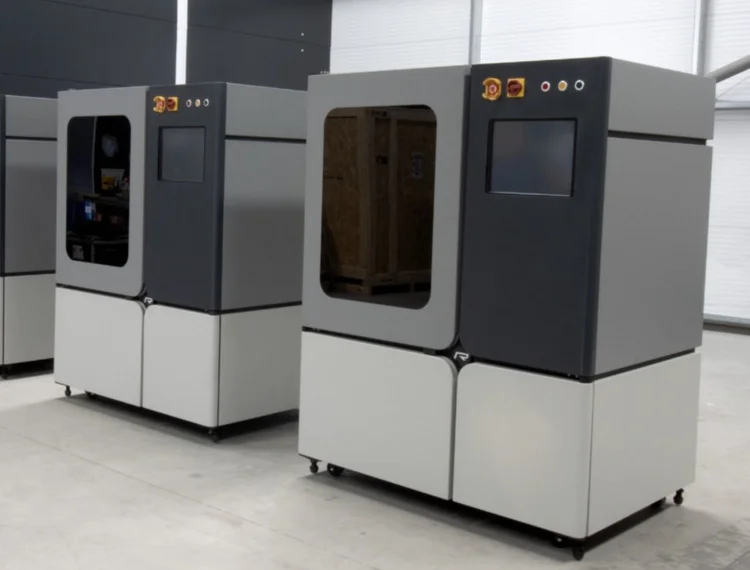
We built our machines with a different assumption from the outset: that a customer should be able to buy one industrial SLA platform and keep it current for a decade or more, not replace it every couple of years. Hardware modules are designed to be upgraded rather than the whole machine swapped out, and software improvements are delivered to existing machines rather than reserved for the next release. It’s a slower, less flashy sustainability argument than “we waste less resin” — but it’s a more durable one, in the most literal sense.
Can a Closed Materials Ecosystem Ever Be Truly Sustainable?
There’s a second, quieter source of waste worth naming: closed materials ecosystems. When a printer only runs its manufacturer’s own proprietary resin, a customer’s options are entirely dependent on that one company’s roadmap. If a particular resin line is discontinued, reformulated, or repriced, the machine’s practical usefulness shrinks along with it — another way perfectly good hardware ends up underused for reasons that have nothing to do with the hardware itself.
An open-materials approach, where a machine can run any qualified resin rather than a single proprietary line, avoids tying a machine’s working life to one supplier’s decisions. It’s a less visible sustainability lever than “less material waste,” but it works in the same direction: keeping equipment useful for longer, rather than obsolete by design.
What Does Build Accuracy Have to Do With Sustainability? More Than You Might Think
Here’s a source of waste that gets almost no attention in industry sustainability discussions, and it’s one we think about constantly: dimensional accuracy across the build platform itself.
Many SLA printers are noticeably more accurate at the centre of the platform than at the edges, partially a consequence of how the optical system is engineered. In practice, that means a part built near the centre might be within tolerance, while an identical part built toward the edge of the same platform, in the same build, isn’t — and has to be scrapped and reprinted. Every failed or out-of-tolerance part represents resin, energy and machine time spent on something that was thrown away rather than used.
We engineered our systems specifically so that accuracy doesn’t degrade with distance from the centre: a part built at the edge of the platform should be dimensionally identical to one built in the middle. It’s a manufacturing engineering problem more than a sustainability slogan, but the effect is a direct one — fewer failed builds means less resin, energy and time spent producing parts that never leave the printer.
Do Engineers Need to Fly Halfway Around the World to Service a Printer?
The large majority of what we manufacture leaves the UK for customers overseas, so “local manufacturing” isn’t a sustainability claim we’d make with a straight face. What is genuinely relevant, given how much of our output is exported, is how a machine gets serviced once it’s a long way from home. Around 90% of servicing can be handled remotely rather than requiring an engineer to fly out. When most of your customer base is international by default, minimising how often that has to happen is a meaningful lever, even if it’s a modest one next to machine longevity or build accuracy.
Beyond Material Waste: A More Complete View of Sustainability in Additive Manufacturing
None of this is an argument against the standard sustainability case for additive manufacturing — the material-efficiency argument is real, and worth making. But treated as the whole story, it lets manufacturers make a sustainability claim without addressing the areas that arguably matter more over a machine’s full working life: how long the hardware itself lasts, how many builds actually succeed, and how tied a customer’s materials choices are to one supplier’s decisions.
Those are harder claims to make convincingly, because they can’t be summarised in a single sentence about layer-by-layer construction. They require a manufacturer to be specific about design life, materials policy and build accuracy, and to stand behind those specifics being checked. That’s a higher bar than most sustainability marketing in this industry currently clears — and it’s the bar we think is worth aiming for.
Long-term value and sustainability often go hand in hand.
Speak with our team to discuss machine longevity, material flexibility and reducing waste throughout the life of your 3D printing operation.